









Welsh Wool Blanket Styling Guide: How to Style Yours at Home
Last Updated: November 13, 2026
Quick Summary
Style a Welsh wool blanket by draping it over one sofa arm so roughly two-thirds hangs down the outside, or fold it in thirds across the foot of a bed with the fringe facing the footboard. A 170 x 145 cm blanket suits most armchairs, two-seat sofas and bed placements, and its reversible double-cloth weave gives you two colourways from one piece.
- Double-cloth weaving binds two layers together, making the blanket fully reversible with a different colourway on each face.
- Fold the blanket in half lengthways and let two-thirds hang down the outside of the armrest to show the fringe.
- A 170 x 145 cm blanket covers an armchair generously and a two-seat sofa neatly.
- Keep to one patterned piece per surface: pair a multi-check blanket with plain cushions.
- The Welsh blankets in our range are recommended for dry clean only.
Which blanket suits your room?Pure new wool Welsh blankets, woven in Wales and fully reversible for two looks in one.
Shop Welsh Blankets
Table of Contents
- Why a Welsh Wool Blanket Belongs in Every Room
- What Makes a Welsh Blanket Different: Weave, Wool and Pattern
- The Best Welsh Blanket Patterns for Home Decor
- Styling a Welsh Wool Blanket on a Sofa or Armchair
- How to Style a Welsh Blanket on a Bed
- Colour Coordination and Pattern Mixing for Autumn Interiors
- Seasonal Styling and Layering Through the Year
- How to Clean Welsh Wool Blankets Without Damaging Them
- Styling Around Pets, Children and Everyday Wear
- Choosing Your Welsh Blanket at TirGlas
- Frequently Asked Questions
Why a Welsh Wool Blanket Belongs in Every Room
A Welsh wool blanket is a woven textile made from pure new wool, traditionally on Welsh looms, and prized for its warmth, weight and reversible double-cloth construction. These blankets have a long history of moving from the back of the airing cupboard to the centre of the living room, and for good reason. They work as a bed throw, a sofa drape and a heritage piece all at once.
The styling case is simple. A wool throw adds texture that upholstery cannot, and it changes with the seasons faster than any furniture. Autumn 2026 colour direction points to terracotta, forest green, berry and blue, all of which sit naturally against undyed Welsh wool autumn 2026 colour trends styled with wool throws. Below, we show you exactly how to place, fold and pair a blanket room by room, with measurements and colour combinations you can copy.
What Makes a Welsh Blanket Different: Weave, Wool and Pattern
Most throws are a single layer of woven cloth. A traditional Welsh blanket is not. The difference sits in the loom, and it changes how you style the piece.
Double-cloth weaving and the reversible pattern
Double-cloth weaving is a technique where two layers of cloth are woven simultaneously and bound together, producing a blanket that is fully reversible. One side shows the pattern in one colourway, the reverse shows it in another. That gives you two looks from one blanket: flip it when you change your scheme, or fold it so both faces show at once. It is the single most useful styling feature a blanket can have.
Pure new wool versus lambswool and blends
Pure new wool comes from fleece that has never been processed into yarn before. Lambswool, taken from a lamb's first shear, is softer against the skin. Blends can differ in durability and price, so choose the fibre that suits how you plan to use the piece. Woolmark guidance is clear that cotton care instructions do not transfer to wool, so treat the fibre on its own terms Woolmark wool care guidance.
The Best Welsh Blanket Patterns for Home Decor
The Caernarfon portcullis design is a pattern many people associate with a Welsh tapestry blanket, and its geometric lattice suits a range of interiors.
Here is how the main pattern families behave in a scheme:
Pattern |
Visual weight |
Best room |
Pairs with |
|---|---|---|---|
Caernarfon portcullis |
Strong, geometric |
Living room, bed |
Plain linen, oak, neutral walls |
Multi-check with stripe |
Medium, busy |
Bedroom, reading chair |
Solid cushions, painted furniture |
Herringbone |
Quiet, textural |
Hallway, guest room |
Grey and stone palettes |
Vintage tapestry |
Heavy, nostalgic |
Cottage interiors |
Antiques, aged wood, wool rugs |
If you want to browse the pattern options side by side, the Welsh blanket collection sets out the heritage behind each design.
Styling a Welsh Wool Blanket on a Sofa or Armchair
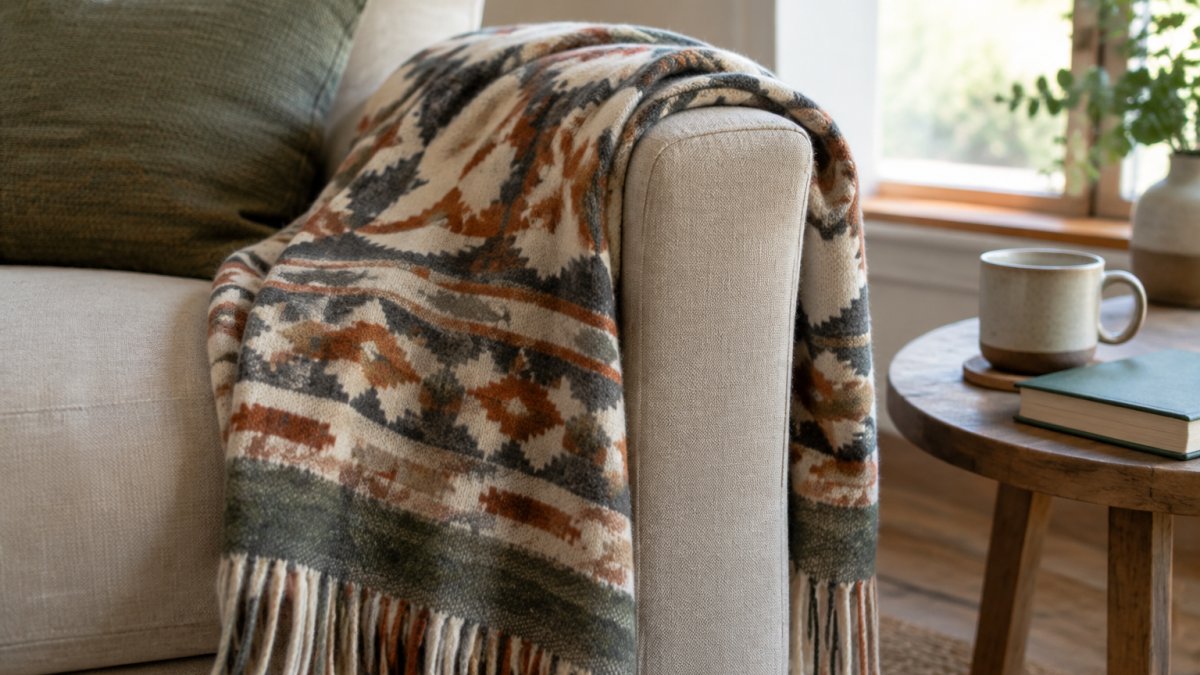
The fastest way to make a sofa look considered is to drape a wool throw over one arm and let it fall in a soft triangle. Not folded flat, not spread edge to edge. One arm, one corner, one deliberate collapse of fabric.
The drape, the fold and the placement
- Drape over the arm. Fold the blanket in half lengthways, lay it over the armrest, and let roughly two-thirds hang down the outside. This shows the fringe and the pattern edge.
- Fold for a chair. For an armchair, fold into thirds and lay across the seat back so the fringe sits at shoulder height.
- Place by size. A 170 x 145 cm blanket covers an armchair generously and a two-seat sofa neatly. On a three-seater, treat it as an accent, not a cover.
- Rotate the face. Turn the blanket over each season to show the reverse colourway. Double-cloth weaving makes this free.
A common mistake is spreading the blanket across the whole sofa. It flattens the room and hides the pattern. Keep the drape tight and let the fringe do the work.
Matching the blanket to sofa and chair dimensions
Sofa and armchair widths vary, so measure your furniture before choosing a size.
Furniture |
Typical width |
Recommended blanket size |
Placement |
|---|---|---|---|
Armchair |
80-100 cm |
170 x 145 cm |
Folded in thirds over the back, fringe at seat height |
Two-seat sofa |
150-170 cm |
170 x 145 cm |
Draped over one arm, two-thirds hanging outside |
Three-seat sofa |
190-220 cm |
170 x 145 cm as accent, or two blankets |
One arm drape plus a folded throw on the opposite seat |
Compact loveseat |
120-140 cm |
130 x 180 cm or folded 170 x 145 cm |
Folded in half lengthways and laid across the back |
Typical width
Armchair 80-100 cm
Two-seat sofa 150-170 cm
Three-seat sofa 190-220 cm
Compact loveseat 120-140 cm
On a three-seater, a single 170 x 145 cm blanket will look mean if spread across the whole frame. Either keep it to one arm or use two blankets in coordinating colourways. For a compact loveseat, a smaller 130 x 180 cm throw folded in half lengthways sits neatly across the back without pooling on the seat.
Room-by-room placement for living spaces
- Living room, main sofa: one arm drape in a strong geometric pattern, with plain cushions on the opposite end to balance the visual weight.
- Reading corner: fold the blanket in thirds and lay it over the back of an armchair, fringe facing outward, so it is ready to pull over your knees.
- Open-plan dining area: drape a smaller throw over a bench or chair back to soften hard lines; keep the pattern simple so it does not compete with tableware.
- Hallway bench: a folded blanket on a bench adds colour and invites use; choose a darker colourway to hide everyday marks.
A common pattern is to treat the blanket as a fixed accessory. Rotate its position every few weeks so sunlight and wear fall evenly, and flip the reversible face to refresh the scheme without buying anything new.
How to Style a Welsh Blanket on a Bed
Layer a Welsh blanket across the foot of the bed, folded in thirds, with the fringe facing the footboard. This is the arrangement that reads as a bed throw rather than a spare blanket, and it works on both a double and a king.
Matching blanket size to bed size
Bed size |
Blanket placement |
Fold style |
|---|---|---|
Single |
Full width across the foot |
Folded in half |
Double |
Across the lower third |
Folded in thirds |
King |
Centred across the foot |
Folded in thirds, offset |
Super king |
Layered with a second throw |
Folded in quarters |
A 170 x 145 cm blanket can be placed across the foot of a bed, and a second throw can be layered for extra depth on larger beds. Fold with the pattern facing up and the fringe aligned to the mattress edge.
Colour Coordination and Pattern Mixing for Autumn Interiors
Autumn palettes often lean on terracotta, forest green, berry and blue, colours that can work well with wool. The rule we use: let the blanket carry the colour, keep everything around it quiet.
- Terracotta and rust: pair with cream walls and natural oak. Avoid red cushions nearby.
- Forest and moss green: layer over grey linen or stone-coloured upholstery.
- Berry and plum: use against pale wood and off-white bedding.
- Blue and navy: works with heather and mint accents for a cooler scheme.
Pairing blanket colours with walls, upholstery and rugs
A Welsh blanket should relate to at least one other element in the room, not sit in isolation. Use this as a starting point:
Blanket colourway |
Wall colour |
Upholstery |
Rug |
|---|---|---|---|
Terracotta and rust |
Warm cream or off-white |
Natural linen or oak |
Jute or undyed wool |
Forest and moss green |
Soft grey or stone |
Charcoal wool or grey linen |
Deep green or neutral |
Berry and plum |
Pale plaster or chalk white |
Pale wood or off-white cotton |
Muted rose or grey |
Blue and navy |
Warm white or light grey |
Heather grey or navy velvet |
Sand or pale blue |
If your walls are already a strong colour, choose a blanket with a quieter pattern, such as herringbone, so the two do not fight. If the room is neutral, a bold Caernarfon portcullis pattern gives the eye somewhere to land.
Pattern mixing without clutter
Pattern mixing is where most people hesitate. Keep to one patterned piece per surface. If the blanket is a multi-check, the cushions should be plain. If the blanket is herringbone, you can add a subtle stripe. A multi-check piece with a stripe and purled fringe gives you colour without needing a second pattern; the Tintern blanket shows how a single stripe carries a whole scheme.
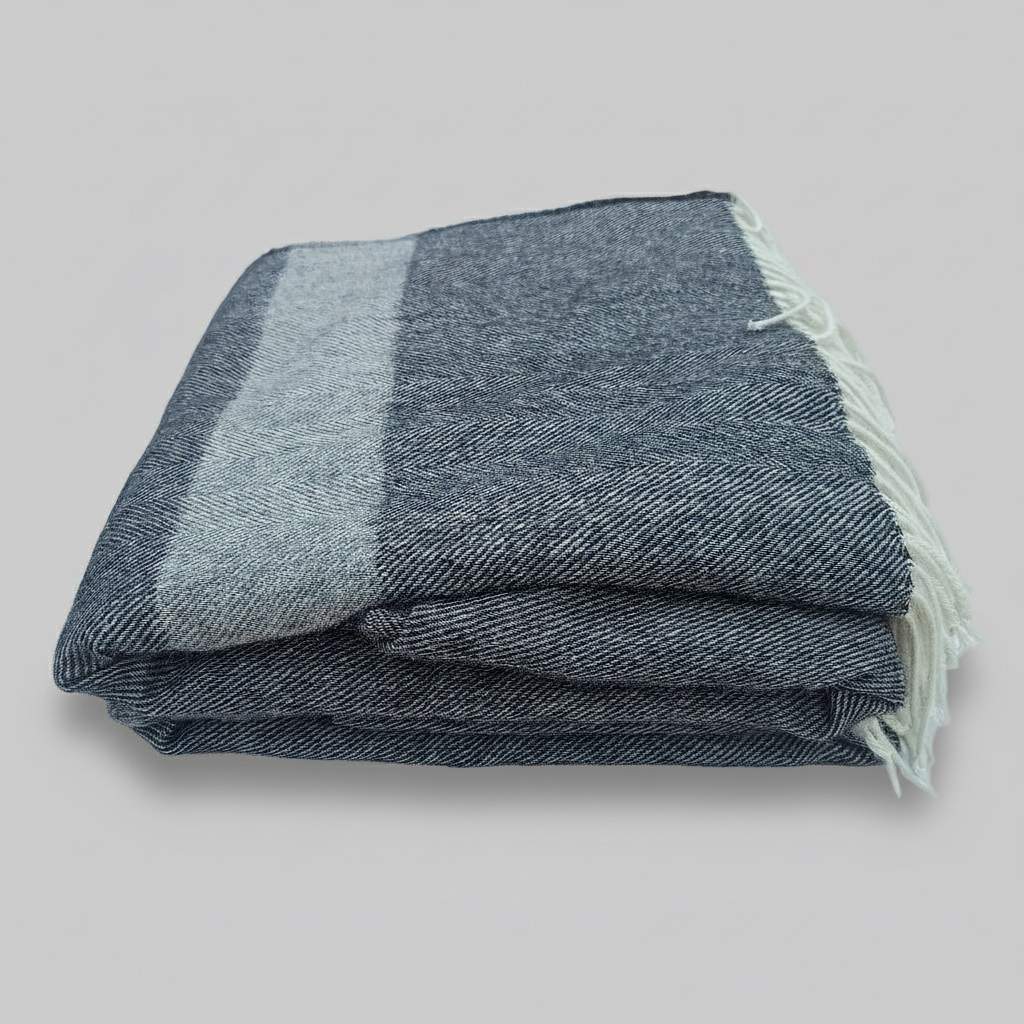
A useful rule is to match pattern scale: a large geometric blanket pairs best with small-scale textures (a fine knit cushion, a tight-weave rug), while a small-scale herringbone can handle a broader stripe on a neighbouring cushion. Avoid pairing two large geometrics in the same sightline.
Watch out: if the blanket has a busy multi-check and the sofa is also patterned, the room will feel restless; break it up with a plain throw or a solid-coloured cushion between them.
Seasonal shifts in colour
The same blanket can be used across seasons by layering it with darker or lighter textiles. Rotate the face of a reversible blanket to show the cooler or warmer side as the light changes. This gives you two colour schemes from one piece without storing it away.
Seasonal Styling and Layering Through the Year
Wool is not a winter-only fibre. In summer, a single folded throw over a chair arm adds texture without heat. In autumn, layer it over a linen sofa with a second wool cushion. In winter, move the blanket to the bed and add a heavier underlayer.
The layering order matters. Put the smoothest textile closest to the body, the textured wool on top, and the fringed edge outward. This keeps the blanket visible and protects it from friction against rougher fabrics. Rotate the blanket's position every few weeks so sunlight and wear fall evenly across the weave.
How to Clean Welsh Wool Blankets Without Damaging Them
The Welsh blankets in our range are recommended for dry clean only.
For the full step-by-step method, including spot treatment and drying, see our guide on how to clean pure wool blankets without shrinking them.
Styling Around Pets, Children and Everyday Wear
A wool blanket in a busy household needs placement rules, not a glass cabinet.
Children's rooms suit a smaller folded throw at the foot of the bed, where it can be pulled up without dragging on the floor.
Choosing Your Welsh Blanket at TirGlas
Start with the room, then the size, then the colour. A 170 x 145 cm double-weave blanket covers most sofa and bed placements, and the reversible face gives you two schemes from one purchase. Our pure new wool blankets are woven in Wales, and each one is named after a Welsh place.
If you are buying for a home rather than a project, the Claerwen pure new wool double-weave blanket is the piece we recommend first: fully reversible, Caernarfon portcullis pattern, and sized to drape over a sofa or bed. Ready to choose? Browse the blankets and pick the colourway that suits your room.
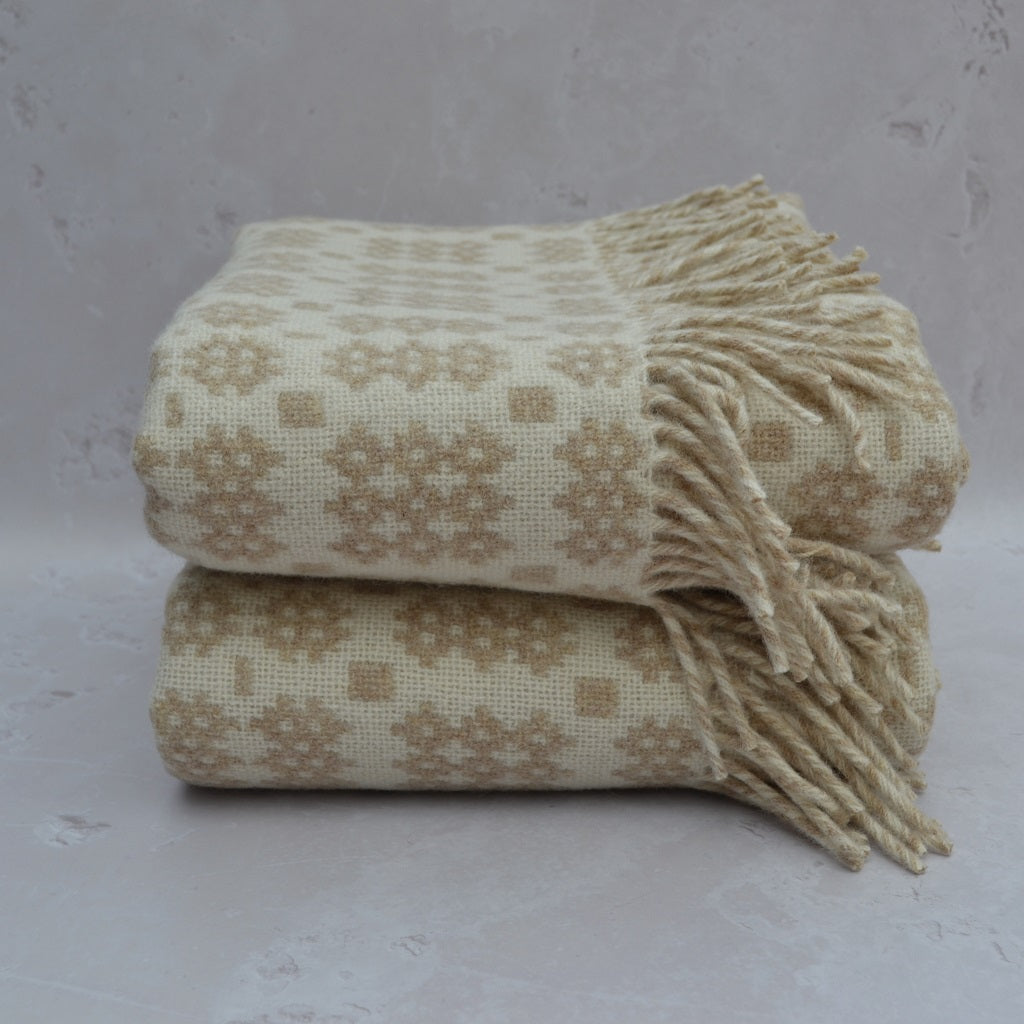
The difference between a blanket that sits in a cupboard and one that defines a room comes down to placement, fold and colour. TirGlas weaves pure new wool Welsh blankets in small batches, with fully reversible double-cloth construction, the traditional Caernarfon portcullis pattern, and a size built for real furniture. Get started with TirGlas and give your living room a piece that earns its place every day.
Frequently Asked Questions
How do you style a traditional Welsh tapestry blanket?
Treat it as the focal point of the room rather than an afterthought. Fold it in thirds along its length, then drape it over a sofa arm or the foot of a bed so the geometric pattern runs vertically. Because double-cloth weaving makes most Welsh tapestry blankets fully reversible, you can turn it over to show the quieter side when the pattern feels too bold. The Claerwen is a 170 x 145 cm blanket.
Are Welsh wool blankets machine washable?
TirGlas recommends dry clean only for its double-weave blankets.
What is the difference between a Welsh tapestry blanket and a carthen?
Carthen is simply the Welsh word for blanket, so in practice the two terms describe the same heritage textile. What distinguishes a tapestry blanket is the double-cloth weave, which joins two patterned layers into one reversible piece. The Caernarfon portcullis design used on TirGlas blankets is woven in this way, giving you two colourways in a single blanket.
How can I incorporate vintage Welsh textiles into a modern living room?
Use one vintage piece as contrast against a calm, contemporary base. Pair a patterned or fringed quilt with plain linen upholstery, pale walls and minimal accessories so the blanket carries the visual interest. Olive, rust and black vintage patterns sit comfortably beside mid-century furniture, while a cream and fawn reversible blanket suits a more streamlined scheme. Keep the rest of the room quiet and let the texture and pattern do the work.
Why are Welsh wool blankets considered a sustainable home decor choice?
Wool is a natural fibre. TirGlas blankets are made from pure new British wool and woven in Wales.
How do I care for a pure wool blanket to ensure it lasts for generations?
TirGlas blankets are recommended for dry clean only, so avoid home washing.
